10 Tips for Naturalistic Sleep

Submission by: Farwa Feroze, OMS IV

Background pattern

Description automatically generated with low confidence

“A good laugh and a long sleep are the two best cures for anything.” – Irish Proverb

Do you feel like you don’t get enough sleep, that there isn’t enough time in the day, or that you’re up late night just staring at the ceiling? Well, you’re not alone; it is estimated that 70% of adult Americans report insufficient sleep for least one night a month and 11% report insufficient sleep every night. (1)

Not only is insufficient sleep detrimental to your health, it can affect every aspect of your life. Many studies have shown a clear link between a lack of sleep and many diseases, including cancer, diabetes, Alzheimer’s disease, obesity, and many more. When we don’t sleep for an average of eight quality hours every night, we decrease our body’s ability to fight pathogens, repair and heal itself, regulate our hormones and blood sugar, as well as many other essential functions. To make matters worse, when we’re sleep-deprived, we’re more likely to make mistakes, be involved in car crashes, and have poor mental health. (2)

Simply put, sleep is preventative medicine. The solution seems simple, just get enough sleep! Unfortunately, it’s not as easy as it seems. But here are ten tips from the American Cancer Society to help work towards restful naturalistic sleep. (3)

  • Go to sleep at the same time each night, and get up at the same time each morning, even on the weekends.
  • Don’t take naps after 3 pm, and don’t nap longer than 20 minutes.
  • Stay away from caffeine and alcohol late in the day.
  • Avoid nicotine completely.
  • Get regular exercise, but not within 2-3 hours of bedtime.
  • Don’t eat a heavy meal late in the day. A light snack before bedtime is OK.
  • Make your bedroom comfortable, dark, quiet, and not too warm or cold.
  • Follow a routine to help you relax before sleep (for example, reading or listening to music). Turn off the TV and other screens at least an hour before bedtime.
  • Don’t lie in bed awake. If you can’t fall asleep after 20 minutes, do something calming until you feel sleepy, like reading or listening to soft music.
  • Talk with a doctor if you continue to have trouble sleeping.

References:

Image retrieved from: https://images.app.goo.gl/zPdEkzmZ79hg36mDA

(1) “The State of in America.” SleepHealth, 24 Sept. 2018, http://www.sleephealth.org/sleep-health/the-state-of-sleephealth-in-america/#:%7E:text=In%20America%2C%2070%25%20of%20adults,report%20insufficient%20sleep%20every%20night.&text=It%20is%20estimated%20that%20sleep,all%20ages%20and%20socioeconomic%20classes.

(2) “NPR Cookie Consent and Choices.” National Public Radio, 20 July 2018, choice.npr.org/index.html?origin=https://www.npr.org/2018/07/20/630792401/sleep-scientist-warns-against-walking-through-life-in-an-underslept-state.

(3) Simon, Stacy. “10 Tips to Get More Sleep.” American Cancer Society, 5 May 2020, http://www.cancer.org/latest-news/how-to-get-more-sleep.html.
Conscious Breathing

Submission by: Priya Singh, OMS III

stones, meditation, balance, relaxation, gartendeko, garden design, rest

Image accessed from: https://www.hippopx.com/en/stones-meditation-balance-relaxation-gartendeko-garden-design-rest-98391


This breathing exercise is meant to give you a quick mindfulness break between your busy day at work or otherwise.

For this exercise, finding a quiet place would be ideal but it can be performed anywhere.

You can do this laying down, sitting or reclining. You do not need to force any breaths but just simply observe your breath with mindfulness.

A Quick and Simple Meditation Technique

● Start with closing your eyes
● Focus on each breath you take, try to not let your mind wander and refocus whenever
that happens.
● As you inhale, feel the air enter your nostrils.
● Focus on the temperature of the air entering your body.
● Feel the air inflate your lungs, and chest.
● Feel the air as it makes your stomach rise.
● As you exhale, feel your stomach flattening.
● Feel your lungs and chest deflate.
● Feel the air leaving through your nostrils.
● Focus on the warmth of the breath that you are exhaling.
● Also, as you are inhaling, feel all the positive energy, peace and calm enter your body.
● As you exhale, feel all the negative energy leave your body.
● Continue to do this for 8-10 breaths.
● Then slowly open your eyes, and go on with your day with renewed energy

Flavors in Transition

Submission by: Anil Harrison MD

Image accessed from: https://www.flickr.com/photos/visionwithin/149553091

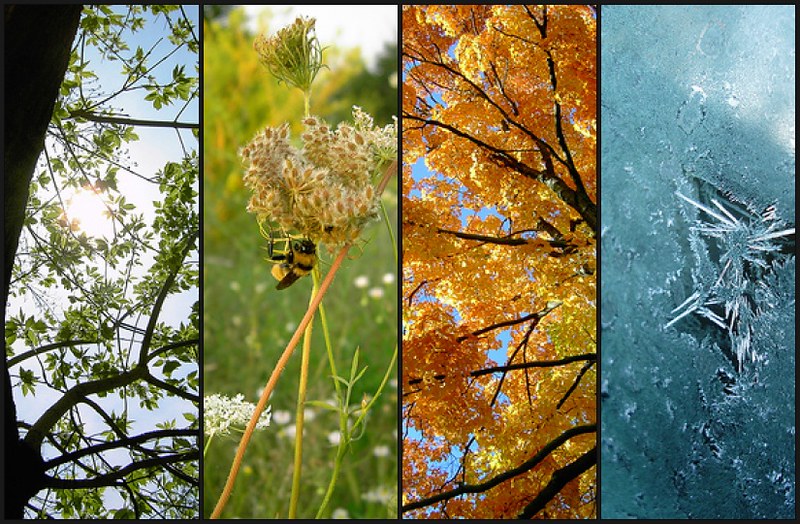
While sitting on my patio one late evening, I mused on the flavors of life akin to the changing seasons…

       Flavors in Transition

Sitting in the dark

the flow of a gentle breeze, the sound of crickets and a distant train 

The early morning calm, it’s freshness and a yearning for music of rain.

The summer has passed me by, I feel a wisp of cool around the bend

The leaves dazzle with colorful radiance,

And pretty petals near their end.

Soon the cold shall turn nature bare 

Though festivities and cheer will fill the air

With gloomy grays, the soul might despair 

Sitting by a fire, there’ll be warmth to share.

Flavors of spring shall blossom next

With changes….at the creator’s behest 

New beginnings, some a challenge while others a pretext

The soul never fails to rise, nor lose its zest.

The sound of crickets and birds, the heart shall miss

Moments in the thicket and abyss, and much more to remiss 

The seasons share beauty, with musings of bliss.

With every passing night, a day shall follow

To turn despair into cheer and wallow

Akin to a ray of hope that kindles one’s hollow.

 Life in ways takes turns in showing

The overcast skies aren’t done a glowing 

A story it tells without an end, an intent sublime and growing

Sitting in the dark, the breeze gentle and time’s aflowing…

My dawn has broken through and cherishes a’ glowing.

Empty your mind

Submission by: Douglas O’Connell, OMS III

We’re in the constant noise of the 21st century.

There is so much around us and so much to take in.

We see vibrant ads pop up on our computer screens or out our windows. We hear our neighbor’s tasteless music.

We are badgered by the incessant alerts on our smart phones all while craving just one more dopamine hit.

I ask you. I urge you.

Find your focus.

Right now, I’m constantly thinking about all the things I have to do.

There’s definitely an email or two I’ve forgotten to send, and I’ve put off a paper to write day after day. There are notes to write and patients to see. There are things to read and presentations to prepare for.

Dinner? Dishes? Also, my room is a complete mess. As things pile up outside, we forget they pile up inside as well. Everything takes it toll.

I ask you. I urge you. Find your focus.

Some people get lost in a world of imagination.

Others breathe deeply and hum or become a downward dog and sometimes practically resemble a pretzel.

I’ve even seen people sew or knit for hours on end. I’ve even witnessed people telling themselves they want to go someplace else, and then proceed to get there fast, on their own two feet.

Occasionally, people take a stick and hit a small ball into a faraway hole.

I ask you. I urge you. Find your focus.

It could be a goal. It could be a simple task. It’s your way to get away.

Your way to escape the hustle and bustle of your surroundings and the world.

It’s your way to leave the ads, alerts, papers, patients, dinner, dishes, and messes behind.

It’s your passion.

It’s about discovering clarity and breaking free from the chains of your mind. Even if it’s just for a few minutes.

Sudoku? Do it. Everyday. A mountain? Climb it.

I ask you.

I urge you.

Find your focus.

Let us know what YOU do to empty your mind and focus on the NOW

A Letter of Gratitude

Submission by: David Sobel, MD

Image accessed from: https://www.flickr.com/photos/36767313@N00/29681183870

I have been reflecting of late on the many teachers and mentors who I am grateful for. I have taken to recontacting (by phone or letter) some of these special and generous people. 

Here is a letter I wrote to one of them. It shows how even a brief “teaching moment” can have valuable impact throughout a career.

Make each moment,

each encounter (with students, patients, and colleagues)

count

Dear XXX,

This is a letter of thanks and gratitude that I have been meaning to write for several decades.

This story is about my encounter with you one night while I was on call as an intern and you were the attending physician. It is very likely that you have no recollection of this brief encounter but it was one that, as it turns out, had a great impact on my life and career.

Let me explain. One night as an intern on call at PMC I admitted a patient with a GI bleed. We called the attending to come in to consult that night, and it happened to be you. You came in and after hearing the history of the patient, you turned to me and said, “What would you do to manage the patient?” I replied that I would summon the gastroenterologist on call and get their advice on management.

You replied, “What if I were not here, what would you do?” I was somewhat taken back by this, and responded, I would call another gastroenterologist. “Well,” you said. “I want you to analyze the situation and give it your best shot. What would you do? I won’t let you harm a patient with over or under treatment, but I really want you to think through the problem as though I was not here. And, I don’t care if I have to stay all night while we figure this out.”

I was stunned. Most attending physicians and teachers wanted to swoop in, demonstrate how much they knew, impress the interns, and get back home as quickly as possible. You were different. You created a safe environment in which no patient would be harmed. But you wanted me to grow-up as a physician and think through decisions in advance of asking for help. Your insight and generosity as a teacher has stuck with me for many years. I cannot tell you how many times I have shared this story with others as an example of effective teaching.

I have applied what I learned that night to my interactions with patients. I have found that my questions can be more powerful than answers. I have often found it more effective to elicit patient-generated solutions by asking “What do you think might help or work for you?” rather than flooding them with advice.

Similarly, when managing co-workers I will often ask them, “If I were not here, what would you recommend doing or deciding?” I have found this often builds their competence, confidence and leadership ability.

So you see, your night of teaching me at PMC has had happy repercussions throughout my career and I am very grateful to you.

I do hope you are thriving!

Your “student,”

David Sobel, MD

The Power of Music

Submission by: Jorvic Ramos, OMS-III

“It’s fascinating and powerful to think that music, something that has been floating around in our environment forever – that this natural, omnipresent human activity has demonstrable benefit as treatment.”

Sarah Hoover., D.M.A., co-director of the Center for Music and Medicine

There is one universal language that unites us all – music.

Music is all around us. It’s not just the repetitive pop songs on the radio or your fine-tuned Spotify playlists that fit your every mood. Open your ears to the world around you – and you soon realize that music is everywhere.

The singing of the birds in the morning; the mechanical synchrony of your car starting up in the morning; the symphony of alarms, call lights, bed alarms, telephones, yelling of agitated patients during rounds; the calmness, wind, and quiet whirring of your bike’s pedals and chain during an afternoon ride; or the subtle humming of the fan as you study in the evening.

For me, making music is a way of creative expressiveness – something to keep my mind off medicine just for a little bit. However, you can’t deny the healing powers of music. Researchers have studied music interventions and the application of clinical music strategies in medicine. Music can balance the autonomic system by toning down sympathetic activity, allowing patients to relax; it can influence how the mind, body, and spirit interact with one other. Check out the videos below to see some examples how music can bring joy and better health to people.

95yo Julian Lee plays the piano

Henry’s transformation after listening to his favorite music

My quick cover of Stevie Wonder’s Isn’t She Lovely on melodica and piano

For more on my musical endeavors, follow me on Instagram: @jorvicjustinmusic

I am a star. I’m a star, I’m a star.

Submission by: Andrew Tsai, OMSIII

Image accessed from: https://www.wannapik.com/vectors/63498?search%5Bquery%5D=movie+starhttps://www.wannapik.com/vectors/63498?search%5Bquery%5D=movie+star

Life is complicated

Oh so complicated. I realized this when controversy over the identity of the tooth fairy plagued my colleagues. Were magical beings actually invading everyone’s homes or was it simply everyone’s parents? Their conspiracies never swayed me from the truth: my parents were fairies and one day I’d awaken the same powers of dental thievery.

Just kidding. I knew right away the tooth fairy was just a story to help kids not freak out about losing baby teeth, but it always bothered me that the fable even existed – that we had to make this up. It wasn’t until I was older that I fully appreciated the tooth fairy. This story transformed a potentially painful process to an event that kids looked forward to.

After dispelling other noble characters of childhood (like Santa Claus), I took it upon myself to create a personal “tooth fairy story” to reframe my perspective on life.

Life is a movie

Movie (noun): a sequence of consecutive still images recorded in a series to be viewed on a screen in such rapid succession as to give the illusion of natural movement.

The movie of life starts with birth and ends with death. Every moment in the present is a screenshot of the film, and when these images are connected together, the passage of time that you and I experience is created.

Recall the last movie you watched. Pause it at a random spot. If you had never seen the movie, would you be able to determine if the characters on screen were good or bad? Could you deduce that Darth Vader was Luke’s father all along? Would Darth Vader remain evil or would he go on to a redeem himself? You just can’t know from a singular moment.

Movie is life

I like to think everyone stars in their own movie and every encounter with others is an intersection of plotlines. When you meet someone new, you can’t rewind their tape and learn their entire backstory. Nor you can fast forward and see what will happen to them. Because I don’t know who they’ve been or who they will become, I shouldn’t pass judgement or assume anything about others.

Applying the same rationale to ourselves, we only know our own past and have no idea what crazy plot twists lay ahead. With the same open mindedness towards others, we should embrace our own future and all the possibilities in life.

Time is a finite resource for movies. Everything in the film is intentional. Those long pauses in dialogue, subtle changes in the musical score as tensions heighten, hidden pop culture references, and so much more. Movies don’t waste a second and nor should we.

When I feel overwhelmed and unsure of what to do, I take a step back, breathe, and imagine myself on set. Megaphone in hand, the director reassures me:

You’re a movie star. Camera’s rolling. Action.

Just Listen

Submission by: Nicole Hamburger, OMS III

Image accessed from: https://www.clipartkey.com/view/ihJxwx_14-cliparts-for-free-speak-and-listen/

A research study found that “patients spoke, uninterrupted, an average of 12 seconds after the resident entered the room.

One fourth of the time, residents interrupted patients before they finished speaking.

Residents averaged interrupting patients twice during a visit.”

Rhoades DR, McFarland KF, Finch WH, Johnson AO. Speaking and interruptions during primary care office visits. Fam Med. 2001;33(7):528-532.


As a medical student on my second month of clinical rotations, I’ve found that it is crucial for healthcare professionals to take the time to truly listen to their patients. The patients know themselves best and when we take the time listen to their stories, it is our best chance at really making a difference in their lives. I found a quote from Rachel Remen, the Healer’s Art curriculum creator, that aligns with this.

Rachel Remen writes,

“the most basic and powerful way to connect to another person is to listen.

Just listen. Perhaps the most important thing we ever give each other is our attention…a loving silence often has far more power to heal and to connect than the most well-intentioned words”.

Perspective

magnifying glass, see, larger view, examine | Pikist

Submission by: Kathleen Mak, OMS-III

I grew up in a neighborhood where homelessness, drugs, and prostitution painted the backdrop to our daily lives. My elementary school lacked a science and history curriculum, pipe leaks streaked the walls, and our free lunches frequently had mold in them. Although I yearned for an education, nothing really seemed amiss to me at the time. My peers either lived similarly or were going through worse.

Back in our one bedroom apartment, I lived with my parents and brother. On my mother’s side, she grew up in China’s Cultural Revolution. On my father’s side, his family endured the horrors of the Khmer Rouge. As a child of immigrants, I saw my parents put every ounce of effort into providing the best possible life they could for my brother and me. We lived frugally and faced the unpredictable financial cycles of a small business, but I was never short of their unwavering care. Not once did they ever take a vacation for themselves. I’ve always considered myself living in abundance in this respect. Growing up, I imagined life’s happiness was one filled with stability and time well-spent with the people who meant most to me. Part of that is still true. However, I have stumbled upon other paths that also breathe purpose into me. And since some these endeavors go against the grain and pushes against certain structures of power, this is where my parents and I differ in opinion.

Perhaps many families of immigrants can relate to this particular lesson of “keep your head down and just work hard”. So when I shared my thoughts about issues such as racism, prison reform, or my decision to give up my administrative job for a case management position, I was always met with resistance. My parents warned me about hardship. That it’ll be a troublesome path. Dangerous, even. And for years, I wondered how they could live through what they did during their youth and not want better for others. I saw it as selfish. It wasn’t until stories were told and the gift of retrospect that I was lent, not a means of justification, but rather a deeper understanding for their outlook on life.

Imagine a youth, an impressionable time, marked by unimaginable strife. Imagine if any of your words that were even remotely critical of the governing authority, spoken at any timepoint in your life, could be used against you. Interrogations that turned children against parents, husband against wife, and neighbor against neighbor. Or if you dressed, spoke, or held a profession that goes against what the government envisions society to be – you and your family could lose your lives. And perhaps they would take out your entire lineage, too, because of the need to uproot “bad blood”. Steering the middle ground and never standing out just may be the closest thing to a guarantee for survival.

In my parents’ time and circumstance, fighting against injustice could have cost them more than just their lives. However, when I looked around I saw childhood friends come to school with bruises and scars, seen and unseen, trafficking occurring in broad daylight, and needles littering every corner block. It’s a very different time and my circumstances are much more fortunate, but in my world, it is the act of not speaking up or standing up for others that will cost lives.

The work and effort put into becoming a physician has both been exciting and challenging beyond what I imagined. This, all happening alongside the injustices that take place in this country every day, sometimes running like an unseen current, deep and disturbing. Those living through these injustices or fighting against it, it sometimes drives them into the ground for it is taxing and consuming. Many of us medical students are involved in a variety of causes and this can feel draining because we also need to meet the rigorous academic criteria in order to become full-fledged physicians.
I cannot speak for anyone else than myself nor am I asking for anyone’s approval for how I build my own resilience. But reflection and perspective is where I draw my strength from when I don’t quite feel like I’m on solid ground. Seeing family survive what they did, I wonder how far my own limits go. When I sense fatigue and feel the need to step back, I realize that it is a privilege to do so. Many others do not have the luxury of choice to “take a break” from injustice because they are living it, in their past, present, and future.

Where my future paths and crossroads go, I don’t know. And personally, becoming a physician was never the end goal for me, if one even exists. Neither am I simply pursuing happiness, but I do know I seek a life of meaning and purpose. And not one that’s only for me, but also for many others, to relish in.

Overlooked Being a Woman in Medicine

Submission by: Sukhpreet Janda, OMSIII

Women In Medicine Month: Podcast Spotlight
Image from: http://blog.pepid.com/2019/09/05/women-in-medicine-month-podcast-spotlight/

When I’m at the library talking to my female peers, the conversation frequently comes up that we are not recognized in medicine. When someone asks what I’m pursing and I reply “medicine”, the next question is,

“No, like a doctor. I’m in medical school.”

“Oh, like for nurses right?”

At this point, I tend to give up and just say okay. But this conversation has happened more than a couple times, and for many of my female peers, it’s a similar story. Even on rotations, I can see how sometimes I am treated more like the student whose job it is to go fetch things and console crying children while the male students get taught medicine. What’s sad is when female residents and attendings acknowledge this is happening and say they have had to face it as well.

Here’s a quote from Marianne Williamson’s book, A Woman’s Worth to further illustrate how I and many women in the field of medicine feel on a daily basis:

“…the more of us who understand the game and see through the lie and forge ahead in support of every other woman’s right to a passionate response to life, the more we will hasten the end of our jail term. Women have been imprisoned for ages, and in our cells, our hearts, we have carried our true feelings like sleeping children, our spiritual issuance, our love. The prison walls are melting. We’re almost out. And when we fly free, we will carry with us such gifts to the outside world. Our gifts haven’t atrophied; they have grown in power. They have been waiting for centuries, and so have we.

Let’s keep our eyes on the sky. They’ll throw tomatoes; they’ll lie about us and try to discredit us. When we rise, they’ll try to undermine us. But when they do, we’ll remember the truth and bless our enemies and find strength in God. The regime of oppression is almost over; its life force is waning, and only its ghost remains. Don’t tarry too long to mourn its effects; celebrate and rejoice in the new. The past is over. Wipe the dirt off your feet.”
― Marianne Williamson, A Woman’s Worth

Marianne Williamson’s poem really emphasizes standing together, embracing your qualities, and moving forward to prove your worth.

So yes, I am a woman in medicine, studying to be a doctor. I am compassionate, caring, take the time to listen, can console many crying children (which parents and other patients sure appreciate during the visit), anticipate what my patients need and have that ready, sense my patients’ insecurities and fears and address these in a nonjudgmental and caring way, ALL while being their doctor and working with them to provide the best care possible.